Sunday, March 3, 2013

Two Days in Cuenca


February 25th & 26th
 
     The old city of Cuenca is a tourist dream – quaint, cobblestone streets, an outdoor café culture, a colonial church seemingly on every corner, bustling markets, and an ever-changing array of architecture to admire. Granted, there are diesel fumes from the buses to contend with, and some streets on which drivers compete with each other as if at the Monaco Grand Prix, but for the pedestrian with time to amble, Cuenca offers a visual feast of outstanding interest.

Emma prepares for her history research.
     Aside from the churches, most of the buildings are just two or three stories high, each façade in either or classic colonial form, or a somewhat more modern deco style, most in a reasonably good condition with multicolored motifs and balconies frequently garlanded with flowers. There is much more evidence of wealth in this town, brought about partly no doubt by the presence of so many North American and European retirees who have chosen to live here.  Sure enough, we came across several during our visit, especially sitting outside at our breakfast stop, the Coffee Tree café.

     It is difficult to understand the economics of how so many churches can exist in such a small area.  On our last morning I had to find a cash machine to pay for the hotel.  In just a 500 yard circuit, I stopped in briefly to four different churches, all Catholic, each holding a morning mass with just a dozen or so people attending.  In one, the heavenly choir sang courtesy of a CD in a boombox, while in another, it seemed that each member of the small congregation chose to sit as far away from each other as possible, seeking their own space of isolation in which to practice their spiritual moment.


     I do not visit churches for their intended purpose, but am always fascinated by their architecture and artistry.  Most were in reasonable repair, some much more elaborate than others, and each boasting their own stylistic identity. The more modern cathedral, as vast as most I have seen in the UK boasted an oversize statue of Pope Juan Pablo II, and a purple lighting effect over the main altar more akin to a rock concert. The other churches while smaller of course, each displayed wonderful collections of artwork worth much more attention than the few minutes we spent there.

     The city boasts several museums, though we visited just three, one of which, disappointingly for us, was mostly closed due to renovation.  The Museo de las Culturas Aborigenes is an immensely rewarding place to visit, even if, like us, one has only a rudimentary knowledge of history, archeology and anthropology.  This huge private collection of artifacts begins with a selection of fossils and ancient tools through to the relatively modern pottery, beadwork and metal work of the Incas.  The artistry of much of the ceramic work, all from what is now Ecuador, reveals multiple societies over thousands of years with very sophisticated techniques and expression.  Most impressive of all is the ability to get close enough to the work to see it in detail, though we resisted the urge to pick up and handle the pieces. Somewhat more bizarre was the experience of walking through the last gallery while listening to a muzak version of White Christmas played quietly over the PA.


We also visited the Museum of Modern Art on the north side of town that appeared to be housed in a converted monastery, a refreshing change from the great civic galleries one finds in larger cities.  The museum exhibited an extensive retrospective of 50 years worth of work by Nelson Roman, an Ecuadorian artist. We unwittingly found ourselves going back in time through his work.  With no guidebook, we were left to make our own assessments and interpretations – all for the best perhaps.


     Our most significant discovery, of sorts,  proved to be the Café Molienda, a small Columbian restaurant we read about online that just happened to be three minutes walk from our hotel.  Not only was the food fabulously delicious, but it was all gluten-free. It is unpretentious, friendly, and absurdly cheap - $15.00 to feed the three of us, including a shot of something pretty strong to wash down the meal.  It was so good, we went for breakfast the next morning, and then, at Emma’s insistence, back again for dinner the next evening. A mariachi band came in to give us an amusingly corny touristy moment, but if ever you are here, this is worth looking up. 

Street Art - Hard to avoid.
     We returned to Quito the next day, enduring nine and a half hours on the bus, but with no sincere complaints. With books to read, Spanish to learn, the Avenue of the Volcanoes to admire, and three consecutive Die Hard movies to watch, there was little reason to get bored.

Friday, March 1, 2013

Avenue of the Volcanoes


February 24th


     I won’t even begin to estimate the number of people who have travelled the road between Quito and Cuenca over the last few hundred years, let alone the last thirty or forty or so, as tourism has expanded, and this route has become one of the classic journeys to accomplish.  It was interesting to read through some of the online discussions about the trip – do it at night – take the plane to avoid the bus.  For some, the journey is an endurance test, or something to be avoided so that the destination can be reached with the minimum of inconvenience.  I fall into the group who believe that the value of the destination is greatly augmented by the experience of getting there. Besides, we are not talking about being crammed into the back of a pick-up truck with selection of livestock for company. The buses are not uncomfortable, and at the going rate of about $1.00 per hour of travel, certainly good value for the likes of us.

Seen in Machachi - Why not?


     A driver from the Papagayo Inn brought us to the town of Machachi, just a couple of miles away, thankfully via a working cash machine, as we had used up all our available cash to pay for the accommodation (the credit card machine wasn’t going to start working until after 10:00 a.m.). As is often the case here in Ecuador, a bus was just about to leave, so we clambered aboard, found some seats near the back, and settled in for the first leg of the journey to Riobamba, about three hours south. The first half hour or so provided me the opportunity to practice Spanish with a traveler I sat next to– it does seem to be improving.
     The road south from Quito to Riobamba runs between two ‘spines’ of the Andes in this pat of the country for about 125 miles.  As has been true for most of our trip so far, clouds covered the higher peaks of what has been dubbed the Avenue of the Volcanoes.  Eight of Ecuador’s top ten highest peaks can sometimes be seen on this route.  Cotopaxi, the World’s highest active volcano eluded us completely, though we hope to return later in the year when it may be clear.  For all that the clouds hid much from or view, they lent a more mythical atmosphere to the journey. 


     The area each side of the road is substantially populated with farms of maize and potatoes, occasional great greenhouses for flower production, and numerous small towns or villages. These places are typified by unfinished structures, laundry flying like prayer flags, and the ever-present graffiti of both substantial artistic ability and the less creative slogan writing. 
Limited view of Chimborazo


The closest we came to seeing the peak of Chimborazo on this trip
   The approach to Riobamba, a much larger town, is dominated by the great hulk of Chimborazo, the highest peak in Ecuador. The peak of this mountain is actually the furthest land point from the center of the earth due to the bulging of the plant around the equator. We could only see tantalizing glimpses of the lower glacial slopes beneath the clouds, as if to say, “come back another time.”
    Riobamba for us was a whirlwind of moving from one bus to another, with just enough time to get tickets and a quick bathroom stop.  The town is the jump off point for a classic five hour rail journey up the mountains on the Nariz del Diablo train.  Not for us this time, but check out the link to see the local area.
     Despite the fact that we had traveled about half the map distance to Cuenca, it turned out that we had another five and a half hours to go.  The reason became apparent quickly as the bus entered a constant switchback journey climbing up and down great valleys. For a long while, much of this was invisible due to heavy cloud, with visibility down to 100 yards or so.  Shadows of great trees peered at us through the mist, with occasional glimpses of deep, twisted valleys opening up.  Fortunately, our return journey provided more open views of this incredible countryside.  The bus would stop every 10 minutes or so to pick up and drop off more local travelers, and we could see the barely credible farm land, in some cases clinging to the sides of mountains, seemingly ready to deliver their crops as a dump truck might deliver its load.
   About an hour before Cuenca, the bus climbed above the clouds to a very high pass, about 11,500 feet up. The vistas that opened up were truly rewarding.  The evening light added an ethereal quality, at least to our eyes, accustomed as they are to the forests of New England. The disappointment of the views finally giving way to the outskirts of Cuenca was overshadowed by the prospect of being able to actually move again after so many hours on the road.  
   The twilight hours allowed us our first glimpses of the old city of Cuenca as a local taxi took us to our hostel.  After such exposure to the grandeurs of this part of the World, it was something of a shock to discover that our hostel bedrooms had no windows, and the water was decidedly temporary.  Too weary to worry much about it at this point, we simply moved to a nicer hotel around the corner the next morning.

Thursday, February 28, 2013

Moving on from Quito

Saturday, February 23, 2013

Believe it or not, Wednesday was our last day volunteering with UBECI! On the one hand, our first night in Ecuador seems like ages ago. On the other, the past three weeks have flown by. Our mornings in the markets and afternoons learning Spanish certainly demanded concentration and energy. We worked at these tasks diligently, and I was almost surprised at how tiring is was by the end of our commitment there. That notion of getting out of something what you put into it directly applies in our case, as our efforts rewarded us with a sense of accomplishment. We actually helped lots of children to learn and grow, even though three weeks is really just a drop in their buckets. They most likely won't remember us for much longer. However, they enriched our lives more than they know, and we will remember them for a very long time. We feel privileged to have joined their paths even for just a little while.   

 Sadly, the end of our Quito time also meant saying good-bye to our lovely host family: Orlando, Marlene and their daughter Anita. We will miss Marlene's delicious cooking, Orlando's sense of humor and Anita's English skills. Fortunately, after this week's trip, we will see them again for one night before we head northeast. We are grateful for their warm hospitality.
 
 
Our next commitment will take us to Otavalo, which lies on our horizon. To prepare for this, and to shake off the city life in Quito, we are presently relaxing at a beautiful country holsteria called Papa Gayo. This lovely estate is located about half an hour's drive south of Quito, near the volcano Cotopaxi. They have farm animals, walking trails, bikes for rent, and even a jacuzzi. Out here it smells of soil, rain and greenery, just what I'd been craving after three weeks in the noisy and polluted city. 
 
Another feature of this haven is their selection of day trips to fantastic places. Yesterday (our first full day here), we took a trip to Quilotoa, which is a lake in the crater of a volcano. The two-hour van ride proved to be a fascinating part of the trip as we headed steadily upwards into the mountains. Breathtaking vistas surrounded us, punctuated by glimpses of the local daily life: women wearing vividly colored traditional clothing, children playing or herding sheep along the road, men constructing the new highway. We didn't even get impatient waiting an hour for the road to reopen at the construction site. The scenery held our attention, and we enjoyed chatting with our guide, Cristian, and another tourist named Letitia, who accompanied us on this journey. 


Clouds drift in and out of the caldera like dry ice on a stage.
 
As you can see in the photos, the natural formation of Quilotoa is spectacular in both size and sight. Many shades of green undulated across the water's surface, while reflections of vaporous clouds cast their shadows periodically. At 12,555 feet above sea level, we looked down on the lake 1,500 feet below. And so we started following Cristian down the winding path of volcanic ash and rocks. Quite soon into our descent, Letitia, Emma and Cristian got farther and farther ahead, leaving me to reassess the notion of reaching the bottom. The path proved quite steep and I imagined myself taking days to climb back up! So Mike being Mike, he selflessly stopped two-thirds of the way down with me. He wanted me to have a positive experience, and this strategy proved to be the right way to go. We started our slow ascent, alternately climbing then resting, taking in the dazzling scenery at a novice's pace. Other guides with horses passed us going down and offered us their services. We declined because even though it was difficult, I really wanted to accomplish this on my own. Breathing hard at the highest altitude we'd ever experienced, Mike kept encouraging me along, and as we were reaching the top, the other three caught up with us. Perfect timing; no one had to wait for me. By then it was about 3:00 pm, and we were all rewarded with a great meal at the restaurant back on top. Fantastico!
Emma studies geology at the Cañon del Rio Toachi
The next day was more laid-back. Emma chose to do the horseback riding excursion in the morning, and two other American guests joined her. The owner of Papa Gayo, Hilan, led this trip, which we had thought would last two hours. As they were all leaving the driveway, I asked an employee about what time they would return. He said "in four hours". OK then! Good thing Hilan gave them each a bottle of water. 
 
It was a beautiful sunny morning, so Mike and I decided to take a walk up the cobbled road. We passed big fields with lots of cows grazing, railroad tracks with a surprising bus/train hybrid that whizzed by, and a gigantic greenhouse operation growing roses of all colors. The property spanned both sides of the road, and seemed to go on forever. We've learned that these flowers are mostly grown for export to the United States and Canada, and as many of you know, they can cost upwards of $45.00 per dozen at home. Here, you can buy a dozen roses for $2.00 (yes, really).This year was the cheapest ever Valentine's Day for Mike! And those flowers were gorgeous. I believe I appreciated them even more, in fact. 
 
After returning to the hosteria, Mike and I enjoyed a couple of hours relaxing on the patio. I must admit that my legs did rebel a bit, after making them do the Quilotoa hike and then our 3-mile walk that morning. We had tea and juice, and I actually spent quite some time sketching our view from the patio. I hadn't sketched anything for years, and I really enjoyed getting back into it. I've promised myself to make more sketches while we're here. Seems like we have a bit more time now to pursue activities that fall by the wayside at home. 
 
 
Emma and the other riders finally made it back to the inn around 3:00 pm. She loved the trip, getting a chance to ride up and down hills, canter, and gallop a bit when some dogs started chasing their group!  Her legs were worse off than mine, as she hadn't ridden a horse for a year, and had never ridden that long at one time before. But the two days of sore muscles were worth it for her. Quite a memorable day in that respect. 

Friday, February 22, 2013

First Shift Completed

When we planned this trip, we had a choice to either work with just one organization for the whole time, or to split between different groups to find more variety. Variety won out, though at the cost of knowing that our contribution to each group is fairly minimal. Thursday was our last day working with UBECI, the organization that strives to proved education to the children of market workers in and around Quito. We are taking a few days off to travel (more on that later), then we head north to Otavalo to work in the next school.

For those who love children, it is difficult to resist the allure of a charming face, or the ease with which a young child can bond so easily with complete strangers. Fund raisers are well aware of this of course, hence the preponderance of the 'desperate' child gazing into the camera. UBECI have a policy of only allowing volunteers to bring cameras to the classes on their last days of working (and many are here for six months or more, typically in a gap year from college studies). Part of the reasoning is that we are there to work with the kids, not to treat them like tourist attractions. Given that, we can now post some pictures to illustrate more clearly what a day in the life of an UBECI class is like. Shown below is the sequence of volunteers traveling by bus to the market, collecting children, playing, reading, exercising and so forth. This is just one of three different markets we visit.

As written in an earlier post, it can become quite challenging to speculate about how many of these kids will benefit significantly in the long run from what UBECI has to offer. There is no way of knowing at present. Byron and Monica, the two who run the program are more or less forced to operate on a month-to-month basis, with funding often uncertain. We are left with the need to depend on hope - hope that funding will materialize, and hope that all of the efforts do indeed provide substantial benefit to many of the kids in the long term.

In the short term, there is no doubt that many of the kids are eager to attend, and enjoy the activities. They play with the toys, practice reading (in some cases), dance, sing songs, learn about physical exercise, and complete often basic but important elementary activities (such as learning numbers, shapes, or, for some of the older kids, practicing their math facts). At a time when so many people have so much to say and argue about educational policy in all its various forms, there is something very refreshing about simply being on the front lines, working directly with the kids, and seeing the gratification they get from taking a project home to their Mami's and Papi's when they return to their respective market stalls.


Tuesday, February 19, 2013

Election Day in Ecuador


Spoiler alert – Rafael Correa won re-election for President on Sunday. It is interesting to note that this report from the NY Times was filed from Venezuela. Our own poll was not exactly scientific, but interesting to note that all the local people I asked (about ten) did not support Correa.  Aside from a lot of flag waving by various parties in the streets in the days leading up to the election, and a warning that traveling around Quito during the day on Sunday could be difficult, we saw little about the event.  One big difference is that everybody here is actually required to vote.  Our host family traveled away to their hometown of Latacunga, about one and a half hours drive south of here so that they could vote there. People traveling to their birth towns to vote sounds quite biblical to me.

      We of course did not vote, but we did have a remarkable day nonetheless.  Our American friend Jeff who has been here many times now, and is our contact with UBECI, put us in touch with his good friend Eduardo, wife Alma, and adult daughters Saskya and Virginia. We took a taxi ride from our home to the north side of Quito, right next to the main airport (now in its last few days of service – we witnessed some of the last planes flying in and out of the airport, famous for being very close to the center of the city, and for ‘exciting’ landings or take-offs). Of course we had absolutely no idea how the day would turn out, other than that Jeff told us they are a delightful family to be with. Sure enough, the day proved to be a mystery adventure tour with surprises as every turn.
Quito airport - this  picture was taken from a main road as we drove by.
Not our picture, but it shows just how tricky the airport could be.
      Their modest home is a haven for artistic creations, with paintings and sculptures filling the rooms we saw. Eduardo, Saskya and Virginia are all genuinely talented artists. Alma may be too, but we did not see her work.  All of our conversation had to be in Spanish, so this proved to be excellent practice for us – we actually managed quite well, with the occasional help of my Dictionary App.

    Saskya still had to vote at a station right next to one of the larger parks in Quito, the Parque La Carolina which is about half the size of Hyde Park in London (so pretty big). The voting lines were slow, so Eduardo, Alma and the three of us enjoyed a gentle amble among a friendly crowd out to enjoy a leisurely day, walking, biking, eating, or watching numerous impromptu performances by comedians and the like. The most colorful character was a man dressed in exaggerated drag using his persona to sell candy – quite successfully. We also witnessed a free outdoor exercise salsa dance class with about 50 people of many ages and body types grooving along to a leader high up on a stage.  Most notable was the number of men participating, something we wouldn’t see so much at home.  Many more men take pride in their dancing here.
     Once Saskya had completed her obligation, our mystery tour began in earnest.  The three of us were packed into the back seat of an old Jeep, with no real clue where we were headed, other than that it was somewhere north.  A brief stop on the outskirts of Quito for some very tasty take-out chicken and chips provided nourishment (and sticky fingers). We crossed the equator heading north for our first scheduled stop at the Pululahua volcano. Alas, it was raining heavily with no chance of a view, so we will have to wait for another occasion to come here.
   So, it was back onto the main road and a seemingly endless climb out of the Quito valley until we reached the small town of Calacali. It does not seem at all noteworthy at first, and is not on any tourist map I have seen (it has one of the shortest Wikipedia entries I know).  In amongst a collection of half built or run-down homes however is a sweet little museum devoted to a famous Ecuadorian singer from the past called Carlota Jaramillo who lived from 1904 to 1987. There is little reason why most of us would have heard of her, but the museum (actually her old home) offered a glimpse into the life of a singer who once was extremely popular in Ecuador, perhaps in the way that Edith Piaf or Vera Lynn were popular in France and Britain. A boombox mounted on a chair played a CD of her songs as we spent about 20 minutes gazing at old photos and other momentos of her career. I even got to play her guitar that rested against her bed. Amazingly, there was no security of any kind – just an open door, and an opportunity to step back in time to another lifetime.  Sadly, her old home is now surrounded by more depressing buildings, but was well worth the visit.


   Around a couple of corners from Carlota’s home is the main square where we found ourselves next to another monument marking the equator.  We dutifully jumped from one hemisphere to the next, losing count of how many times we had crossed this line (five up until this day), before Eduardo took us to another friend of his who runs a small guinea pig operation, supplying what is considered a great delicacy to the local markets. I don’t suppose they have names, but we did not feel any more inclined to sample the product. The produce we did sample however was of the fruit variety at the home of yet another friend of Eduardo just a few streets away.  We sampled uvilla, chigualcan, taxo and tree tomatoes, all freshly picked from the garden - some more tasty than others. 

Chigualcan - very juicy and delicious

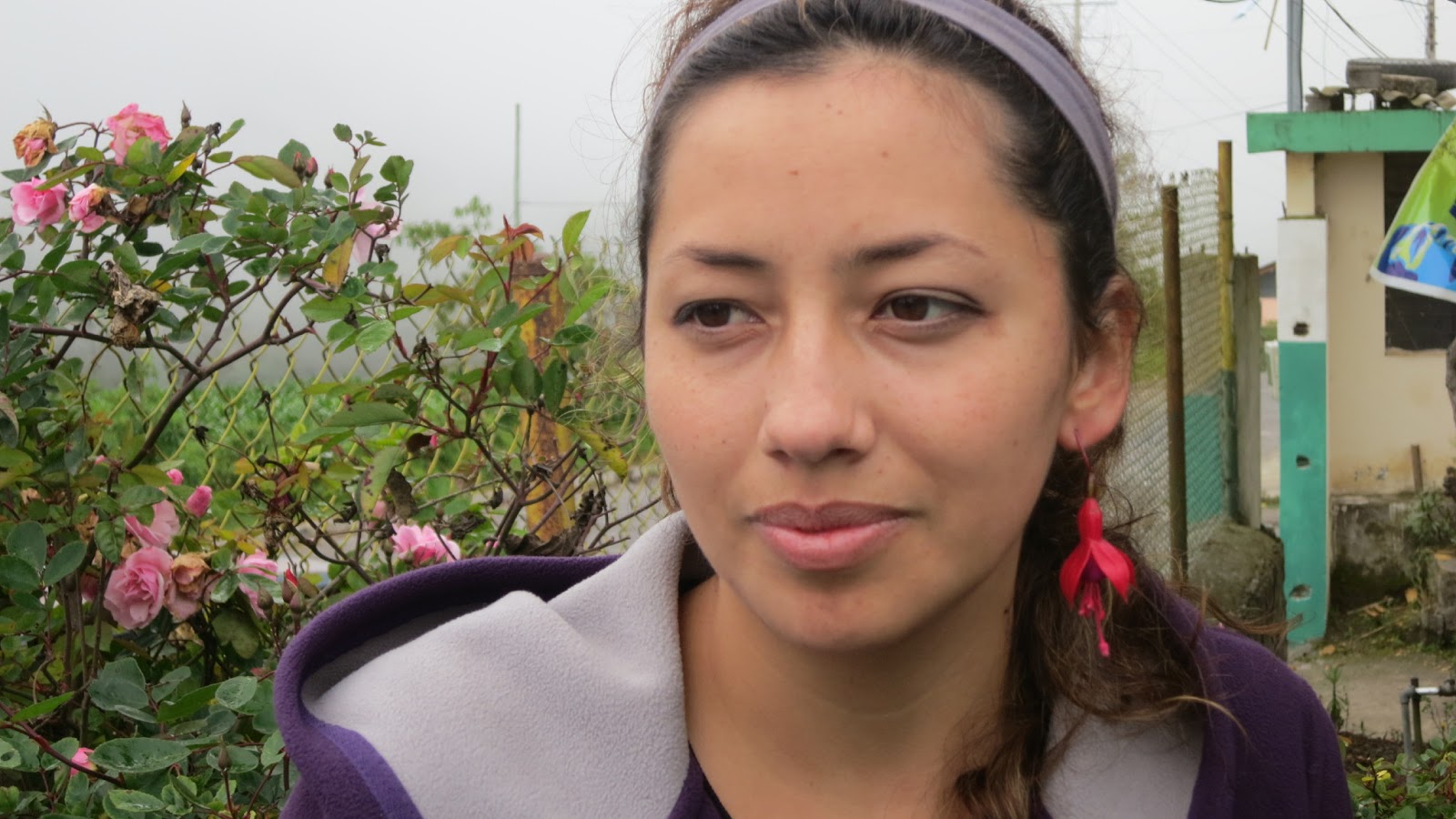
Saskya models the natural earring look
     The last stop on our mystery tour proved to be a small dairy farm even higher up into the mountains just a few miles from Calacali that is somehow connected with Eduardo’s family. The few miles consisted mostly of a steep climb through intensely green vegetation and what, on a clear day, would surely have been spectacular views.  Alas, the vistas were very limited, but a short walk around the farm was refreshing and quaint, with hens, goats, and dogs strutting about as they would in any small farm around the world. Imagine a small, lush field in Ireland turned about 50 degrees to the horizontal.

     It was after 7:00 in the evening by the time we finally got back to Quito.  We had spent several hours cramped in the back of the jeep, but were thoroughly rewarded by surprises, and the delightful company of this artistic family that went so much out of their way to entertain us.  Our Spanish was given a good workout for sure.  They even invited us back, so that could be hard to resist.