Monday, February 18, 2013

Thoughts on Working with UBECI

     UBECI works to serve the children of people work in three different markets around Quito. Two are on the south side of the city, about 30 minutes bus ride from the center (on a good day) while the other is in Sandolqui, a town that is about 30-40 minutes west of the city center. We see some of the children at more than one market as their parents move from one market day to another, but the flavor of each is decidedly different.

     Having spent more than twenty years teaching in essentially traditional schools in the States, it is hard not to be making constant comparisons between my experiences here and there, even though the age group here (3-10) is younger than the adolescents I am used to working with. On so many levels, they exhibit many of the same characteristics – cute, eager, loud, shy, craving attention, curious, disruptive, helpful, mischievous, and more. Some of the kids are especially eager for attention.  They will hold hands, or climb into your lap as easily as if they were your own children.  Others of course are more shy and cautious in their interactions. 
     None of this is particularly different from classes around the world, except the knowledge that most of these children have very limited and irregular schooling.  One day they may be able to join in the activities.  On other days they are needed to help with the work in the market, setting up the meticulously arranged vegetables, cleaning, or helping with customers.  Some of them can read and write at least at a fairly basic level, though most seem to struggle.  When making Valentine’s day cards the other day with the kids, there were several kids in the 7-10 bracket who needed help to write a simple message inside the card, though, enchantingly, they really wanted to express love to their parents.
     In the US, it often seems to me that the most outspoken reason for doing well in school is so that one can get into college. Thankfully, the history of curriculum does indeed go beyond this, stressing the need for literacy in language and mathematics, followed by a host of other skills such as science, health, technology, music and art. Traditional school is clearly such a grind for so many kids and their parents. Everyday I see kids for whom school is something they have to do, rather than something to value and truly enjoy.  This is perhaps inevitable given that many, if not most kids are developmentally unready to appreciate the deeper value of their education. They must rely on a good support system from their families, communities and, hopefully a strong school system to see them through to a place where they can take advantage of opportunities available for their futures.
     Here in Ecuador, with our very limited experience in the schools, it is not yet possible to pass too much judgment on what drives people to do well in school.  The 16 year-old daughter of our home stay is clearly driven to work hard, leaving home before 6:00 a.m. to travel for about an hour to her school.  Another member of the family, David, is studying biotechnology in college and is striving to become part of unlocking the secrets of rainforest plants to better serve us, without in the process causing further degradation.  Business and health opportunities abound, but it appears that there is a significant shortage of sufficiently qualified people to enter these fields.  Elementary participation is very high (over 90%), but only about 60% of the childhood population goes onto secondary school (as compared with 90-95% for the USA and the UK).  There is a great deal of pressure for children to enter the workforce, which often means working in agriculture.
     So, I look at the children in the markets, and wonder about their social mobility.  Is it really any different from what we hear about in the USA and the UK, that social mobility has diminished in recent years? That is a tough question to answer. Faced with the enormity of understanding how education for children can be improved, and to what end, I revert back to the message of the Buddhist story about a monk walking along a beach with his disciple.

“Thousands of starfish had been washed up onto the shore after a fierce storm. Stooping down, the monk lifted a single creature and returned it to its home in the sea. The disciple asked why the master did this when it made so little difference to the mass of stranded starfish. As the monk lifted another single starfish he replied,
“It makes a difference to this one.”
And he tossed it back into the sea.

Sunday, February 17, 2013

Las Cascadas by Chiva-Bus

After a day of celebrating El Carnival in Ambato, Monday was somewhat more sedate for us.  Nan, Emma and I enjoyed a leisurely breakfast in one of the many restaurants on the main street in Baños. It is a challenge for Emma and I to go without much of the delicious looking bread that is available everywhere, so we make so with eggs, bacon, fruit, and, after a couple of suspect attempts, some delicious juice.  We had no big ambitions for the day. The other volunteers had all left early in the morning for another town some hours away, but we were in no mood for additional travel.  Nan and Emma went for a dip in the local hot springs, but they reported not being too happy with the extent of the holiday crowds all vying for the same space.  Far from being a ‘natural’ experience of taking a dip in some rock pools, these were more like oversized Jacuzzi’s, leaving one to wonder just what the source of heat really was.
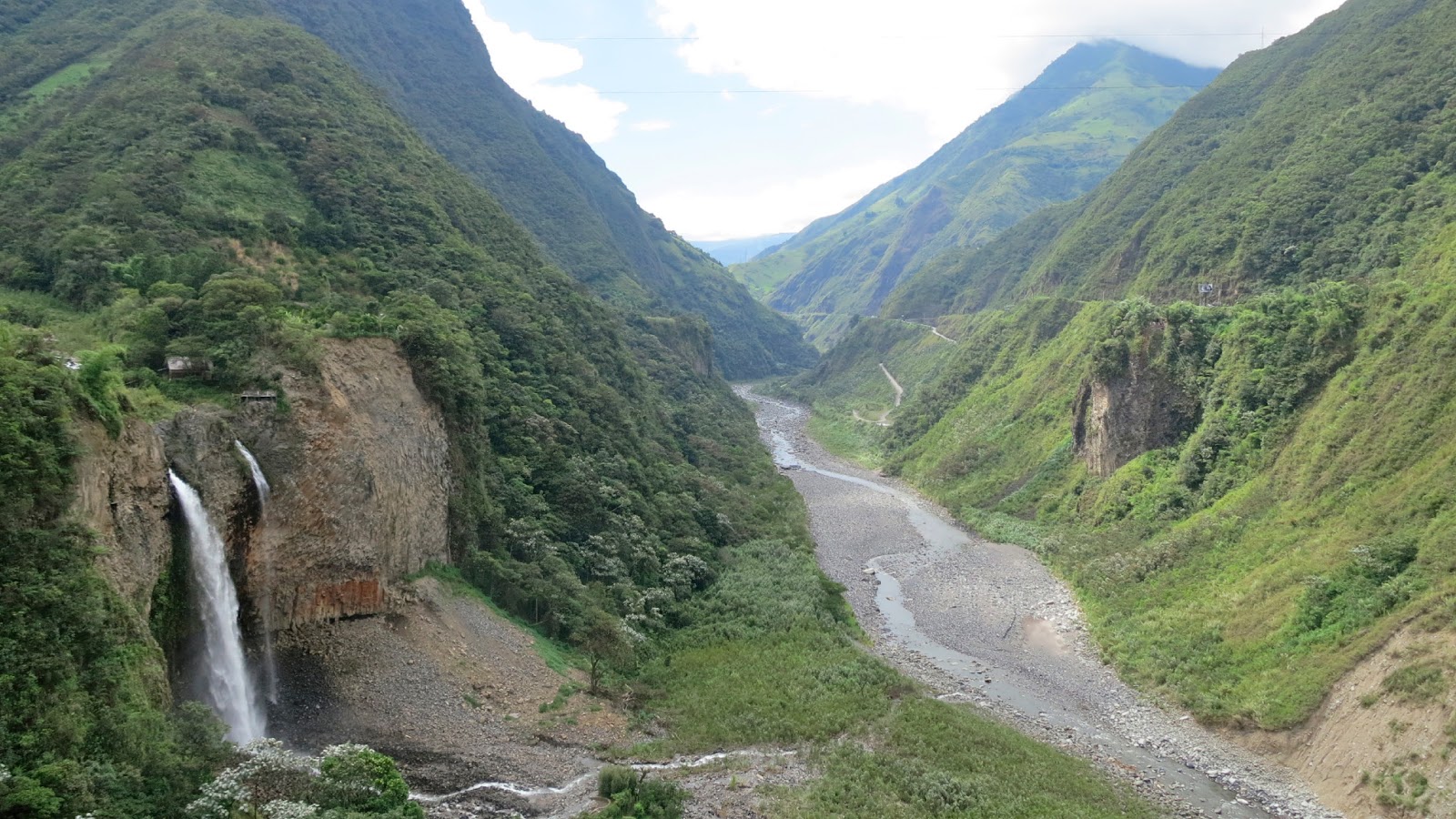
For my part, I preferred the idea of sightseeing outside the town.  Along with many restaurants and bars, Baños boasts a wide selection of adventure travel shops geared towards kayaking, river-rafting, climbing, biking, jungle tours and more. It wasn’t hard to find the tour to suit my needs, so for $5.00, I booked a two and a half hour tour by ‘chiva-bus’ to some of the local waterfalls or ‘cascadas’. So, in the early afternoon, along with about 25 others, I scrambled into the back of what is essentially a covered truck, and we ventured east out of Baños, following the River Pastaza for a few km, past a large hydroelectric dam to the first of two sets of falls we would see. It was somehow awe-inspiring to think that the water from this river would eventually flow into the Amazon. All along the route I sat in the very back next to a discotheque-sized speaker that, fortunately, played a reasonable selection of music that didn’t quite destroy our hearing. 


Our first stop at a point where the river gorge is a few hundred meters wide afforded us the opportunity to climb aboard a very small cable-car that takes about 10 minutes to cross the gorge and back. I put my faith in the safety inspectors, paid my $1.50, and ventured across with half a dozen others.  It is indeed a truly spectacular location. Most amazing of all to me was to see that despite some incredibly steep slopes on the mountains, farming was still very evident high up above the valley floor. Getting up every morning to go to those fields takes some doing, especially as I could see no evidence of any roads to some of these areas.


Another favorite activity in this region is zip lining. Our tiny cable car was quite sedate compared to the zip-lines stretched across the very same valley. I watched a couple of people do this, wondering if I could pluck up the courage to do it myself (I think I can). The valley is wide enough that the people pretty much disappear from view by the time they reach the other side.  This option was not part of our current tour, but Emma seems willing, so hopefully we will get the chance again.
The chiva-bus then travelled another few kilometers east to another set of falls. We had to walk for about 15 minutes along a narrow path through some very equatorial looking vegetation, then across a decidedly wobbly suspension bridge to view these falls, whose name I am unsure about (I don’t think they are the famous Falls of Agoyan, which are a little further down river, but they are impressive nonetheless). Even more precarious than the bridge (which is at least held up by substantial steel cables) are the flimsy ropes that supposedly protect people from falling into the gorge below.  A narrow path descends down the side of the gorge, with, on this occasion at least, dozens of people moving in both directions. I made a point of being extra careful, and soaked up (almost literally) the impressive nature of the Falls.
The tour allowed us just forty minutes before we had to return to the bus, next to which was a very convenient food stall selling fried plantain. Served up in a natural plate of the original skin with a little butter, it was truly delicious.  The return journey meant running the gauntlet of several kids determined to continue the spirit of Carnival who launched water balloons, eggs and spray foam at the tourists.  One balloon landed squarely on the head of an infant right next to me as she was being nursed by her mother, both of whom were thoroughly drenched.  Such is the way that culture is infused from one generation to the next.

Tuesday, February 12, 2013

Carnival Weekend

--> “It is known that the Huarangas Indians (from the Chimbos nation) used to celebrate the second moon of the year with a festival at which they threw flour, flowers and perfumed water. This once pagan tradition has since merged with the Catholic celebration of Carnival.” (Wikipedia).  This weekend, we decided to find out for ourselves what Carnival is about by travelling a little over 100 miles south of Quito to see the renowned celebrations in the town of Ambato.  We actually stayed in the town of Baños about an hour away, partly because Ambato had no available accommodation, but also because Baños is, in its own right, a town with much to offer the traveler seeking adventure and fascination. 

One hundred miles may not seem much to the European or North American traveler, but for us it involved a four-hour bus ride. The three of us went with four other UBECI volunteers, Cecile, Jill, Olivia and Madi.  Nan and I are old enough to be parents to all of them, but that did not seem to be a problem.  The coach was comfortable enough, though it did take a somewhat tortuous route through the back streets of some towns, once even taking a dirt track for a few miles.  Whether this was to avoid traffic, tolls, or broken roads was unclear, but either way, we saw much of the backstreet life, people farming small plots of land, the ubiquitous homes for ever under construction, some impoverished districts, and a considerable amount of very large greenhouses, likely growing areas for flowers which represent a significant chunk of the Ecuadorian export market.  On either side are the mountains that, at this time of year are shrouded in a constant layer of clouds, though still strangely impressive and mystical.
The last part of the journey into Baños is a long descent into a gorgeous valley overshadowed by the towering active volcano of Tungurahua (Throat of Fire). It last erupted in April of 2011 though is currently napping.  The entry into Baños passes through a chasm of volcanic rock that is impressive even in the light of dusk.  Given the earthquake we experienced this morning in Quito, it was quite a day for earth science experiences. 

Tungurahua - on arrival.
 Once in the town, we found our way by foot to the Hostel San Sebastian where we could all share a comfortable room for about $15 a night per person. Baños is a lively tourist town with many restaurants, bars, Internet cafes and a teeming street culture of performers and tourists (mostly Ecuadorian but quite a few Norte Americanos and Europeans too).  After a pleasing dinner (about $5.00 each), the youngsters all decided to crash, leaving Nan and I to watch some clowns perform in the main square and to sample a little wine while watching the street life pass us by.  Our hostel was very much in the center of town, so going to sleep was accompanied by the reverberations of much late Saturday-night revelry.  

Baños
 The next morning began with a bus ride to Ambato, a significantly larger town back up the valley we had descended the previous night.  The usually hidden peak of Tungurahua was just visible above the clouds, but thankfully still quiet. The journey took a little under an hour.  A local city bus took us into the center of town where we joined a steady stream of people heading for the main street to watch the Carnival parade.  
Tungurahua - Peak just visible.
  Alas, our inexperience meant that we did not get as good a view as we would have liked.  Every side street leading to the parade was well packed with people as eager as us to watch the events. After trying several streets, we settled on one with limited views, packed in with a hundred or so in the narrow street. The parade itself is a feast of music, dance, and numerous floats celebrating the ‘Fiesta de las Flores y de las Frutas’. Sure enough, the floats are a wonderful collection of creative displays festooned with thousands of flowers and fruits, each one also adorned by two or more beautiful young women (in this case defined by being tall and skinny, with long, dark wavy hair). Each float was accompanied by either a troupe of dancers in meticulously fabricated costumes and/or a live band trailing behind. It was a strain to see clearly, but holding my camera at full stretch has provided us with pictures and videos we can view at leisure a little later.


The compensation for limited view was participation in the crowd revelry.  The single most important possession is a carioca – an aerosol can that can unleash a stream of foam spray, effective up to about ten feet.  I dread to think about the carbon footprint of this habit, but there must be millions of them sold during Carnival each year.  Nobody is really safe, especially if you are seen to be carrying one of the cans.  Being a white tourist also makes one a target.  My vantage point for the parade was tightly packed in with a group of ‘lads’ armed with their carioca cans and fortified by a rapidly diminishing case of Pilsner (this was 10:00 a.m.).  Foam fights break out with increasing frequency, and at no time can one be considered ‘safe’.
Ammunition dumps cater for new supplies!

Our relatively poor viewing spot meant that we did not stay for the whole parade (which went on for about two hours), so we wandered along other streets where there was plenty to watch – vendors, street artists, and children constantly lurking with their carioca cans. The Carnival is officially a four-day event, with live music, dances, parades, bull fights (which we declined), and exhibitions all on offer.  We spent most of the rest of the day around the main square of the town joining with thousands of others simply soaking up the atmosphere, and periodic fights with the foam.  I took to carrying my can ‘holster-style’ in my pocket, and developed a quick draw technique whenever threatened.  However, it is hard to retaliate against a three-year old girl brandishing a carioca, firing left and right from the protective comfort of her grandmother’s side.


We returned to Baños in the early evening for a quieter (and delicious) meal there, still on the alert for guerilla carioca attacks. Appropriately enough, a local band played a considerably extended version of Lou Reed’s Walk on the Wild Side.  Doo, de doo, de doo, doo de doo doo, de doo, de doo, doo de doo doooooooooo.

Ride the Bus

Friday, February 8th

Quito


Maynard and surrounding towns don’t have public transport, apart from the school buses and a service for senior citizens at certain times. Try hailing a taxi, and one is likely to be stranded for a while. We are left with either our own cars, bikes, or walking.  Such is the nature of suburban existence in New England.


It is thus quite refreshing to live once again in an area where buses and taxis dominate the traffic.  It is all the more entertaining to experience a more vibrant bus culture than is normally found in the Western cities with which I am familiar.  A ride here begins with a manifest statement of trust non-existent in London or Boston. One simply climbs aboard with a nod of acknowledgment to the driver perhaps, and then you only pay at the end of the journey. Most trips cost the grand sum of 25 cents, though a trip to the next town does stretch to 40 cents. That alone might seem to be enough to provide satisfaction, but there is more.


Our work day starts with a bus commute to one of three different markets around Quito.  The volunteers meet in the UBECI office at around 8:45 in the morning (which for us is just two minutes walk from our home) where we gather bags of toys, books, mats and other supplies for the day.  The bus stop (Parada) is just around the corner too.  We rarely wait more than three to five minutes for the right one to arrive with a conductor usually hanging half out of the door seeking out potential riders. We clamber aboard, through either the front or rear door and usually find a sit. 


Within minutes, we can expect the first round of commercial entertainment.  This is not the TV feast of violent movies or Latin soap operas one might find on long distance routes. Rather it is a succession or traders with a wide assortment of goods to sell.  Snacks such as candy, nuts, popsicles and other items I have yet to identify, plus CD’s and videos make up the bulk of the wares on offer. Each comes with a sales pitch of course, delivered with varying degrees of enthusiasm and marketing talent. Some choose to make a short speech before walking down the bus pushing items within inches of noses for people to see, while others will give out some free samples hoping for some payback (often effective). Each sales person may only be on the bus for just a few minutes, stepping off to make way for the next one to enter soon after.  There appears to be a rule that only one can work a bus at any one time, and they don’t seem to pay a fare.  I can only presume that there is some kind of a licensing arrangement, official or otherwise.


The music or video sales are hard to miss, as the pitch is accompanied by the vendor carrying a battery-powered speaker or video player. The music may be Michael Jackson, Gangnam Style, or, as was the case today, a cheesy mix of 118 Latino romantic songs  (supposedly all on one CD). Bob Esponja proved to be another short addition to the morning commute.  DVD and CD packets are passed out for passengers to review, most of them returned to the vendor.  I have not seen too many sales, but the ongoing presence of such a business suggests that there is some value and sustainability for those who put in the hard work.


Our rides typically last about 20-30 minutes.  We descend onto a narrow and busy pavement where the conductor collects the fares before the bus moves on, sometimes leaving behind a thick cloud of fumes for us to avoid. Meanwhile, John Travolta and Olivia Newton John’s, ‘You’re the One that I Want’ greets us from a local store.  We’re off to the market – o, o oooooo!

Thursday, February 7, 2013

Another Day, Another Market.

-->
February 6, 2013

It’s Wednesday evening, and we’re back at our host family’s place after another day of volunteering. We’ve started to get into a routine here, which is to be with the kids in the markets every morning, lunch back at Marlena’s, (our host “mom”), then back to the UBECI office for Spanish lessons from 2 until 5pm. Upon returning “home”, we have time to relax and have tea. Supper is served between 7 and 8 pm, depending on what the family is doing. It’s a full day, with little extra time to do other things. It’s understandable that the volunteers get Mondays off! This also allows them to travel for a few days to see more of this fascinating country. Ecuador is about the size of New England, but it has such a variety of things to offer: mountains, rainforest, beaches, markets, scenery, cool weather and hot, humid weather.

The children, as usual, are really sweet. We gathered inside yesterday because it was the fourth day of rain. One of the volunteers, Tammy, led some of the kids and volunteers in a Karate lesson! Generally, we follow the basic format that I described earlier: playtime, singing together, movement, smaller group lessons, clean up, and then we return the kids to their families. Occasionally there’s something special, like the Karate lesson.

February 7, 2013

Last night, Emma and I experienced something special ourselves: we went to a local dance class with our host daughter, Anita. Because I’m not cooking dinner here, I decided to go out and give it a try . The hour-long class is mostly Salsa and Samba, and there were about 20 students, including many men. Our lack of Spanish didn’t matter because we just followed the instructor (or rather, tried to). I must admit that Emma and I were dripping in sweat afterwards. Anita, not so much! Mind you, she has been dancing Salsa all her life, and she breezed through the class no problem. It was really fun, and some of the other volunteers will join us next week!

Today was sunny (sorry, Boston!), and we went to another market one hour away by bus. It’s in a smaller town but the market was jam-packed with people selling everything from mini kiddy pools to roasted pig’s heads. Many vendors were literally wearing their wares, with strings of limes tied together around their necks, or bags of candies on big rings around their wrists. Every other person yelled “un dólar” as we pushed our way through the crowded streets and dodged slow-moving cars attempting to pass through. And of course there were children selling things alongside their parents, or children playing with whatever was to hand. This is the reality for so many kids here. 


In total, we gathered up 50 kids today and brought them back to our make-shift classroom outside, behind a church. 


I held three babies throughout the morning, which I absolutely love doing. They were so sweet and calm while watching the other children play and sing. By the time I held the third one, however, it was close to noon and past his nap-time. He couldn’t help but cry at that point, so I mined my bag of tricks and sang him the songs that used to work on Emma. After a few minutes he was out like a light. Baby Bliss!

Monday, February 4, 2013

Learning More in Quito


Monday, February 4th
Quito

When traveling to another country, it is important for many to experience the subtleties and depth of the culture, be it the food, the music, the landscape, or perhaps the history.  Last night, with most of the USA (and others perhaps) doing their best to either watch or avoid the Superbowl in New Orleans, and Ecuador apparently largely oblivious to the event, we were introduced to a vital part of Ecuadorian culture, Cuarenta. Instructions from online read, “When making a caída, a special flourish is employed. The card is sometimes "snapped" down on top of the captured card with great vigor and from well above the surface of the table. Then, both cards are taken as usual. This is a purely friendly, but nonetheless rib-poking, gesture.”

Cuarenta (forty) is an Ecuadorian card game that is unlike any other I have played, and involves a few intricate scoring rules.  Last night, Orlando (our home-stay host) taught us the basics.  Tonight he is bringing in another family member to really test our mettle. We will certainly practice the “special flourishes.”

Meanwhile, we have spent most of the last three days acclimatizing to our situation here, and enjoying the fact that we do not have to spend every day preparing to leave our home.  Emma, alas did get sick on Saturday with a throw-up bug and stomach pain, but that only lasted a couple of days.  Now she is back to her smiley self, looking forwards to starting some dance classes at a gym next door with Anita, the 16 year-old daughter who lives here.  At $2.00 a pop, it sounds like a deal.  Nan and I may even try some Salsa lessons.
Things that are different: Milk in a bag.
I took my first solo walk through part of Quito on Saturday, a two hour sojourn up to the top of El Panecillo, a hill overlooking the center of the city with a 40 meter high aluminium statue of the Virgen de Quito.  It is a long climb up many steps, and only afterwards did I read the reports that some parts of the steps at the bottom of the hill are notorious for tourist muggings.  I was following a couple of nuns so maybe they kept me safe. Next time we will take the bus.  Quito, at a little under 10,000 feet is the second highest capital city in the world after La Paz in Bolivia.  My lungs certainly felt it, and were grateful for reaching the top.  The view reveals the shape of Quito – a long, narrow city sandwiched between the higher mountains on either side. Needless to say, the downhill portion was substantially easier and the two hour walk was well worth the effort.

Not a good place to lose a ball when playing football like this kid.

Approaching the top....gasp!

A cloudy day, but still a spectacular view.

Saturday, February 2, 2013

First Day at the Market

-->
February 1, 2013

Hello Everybody, Nan here. I’m happy to tell you that we finally got to be with the kids this morning!  We met about ten other volunteers at the UBECI office. There are people from the States, Australia, Canada and Europe, most of them college age and many have been here for at least one month. Two volunteers are staying for six months. 


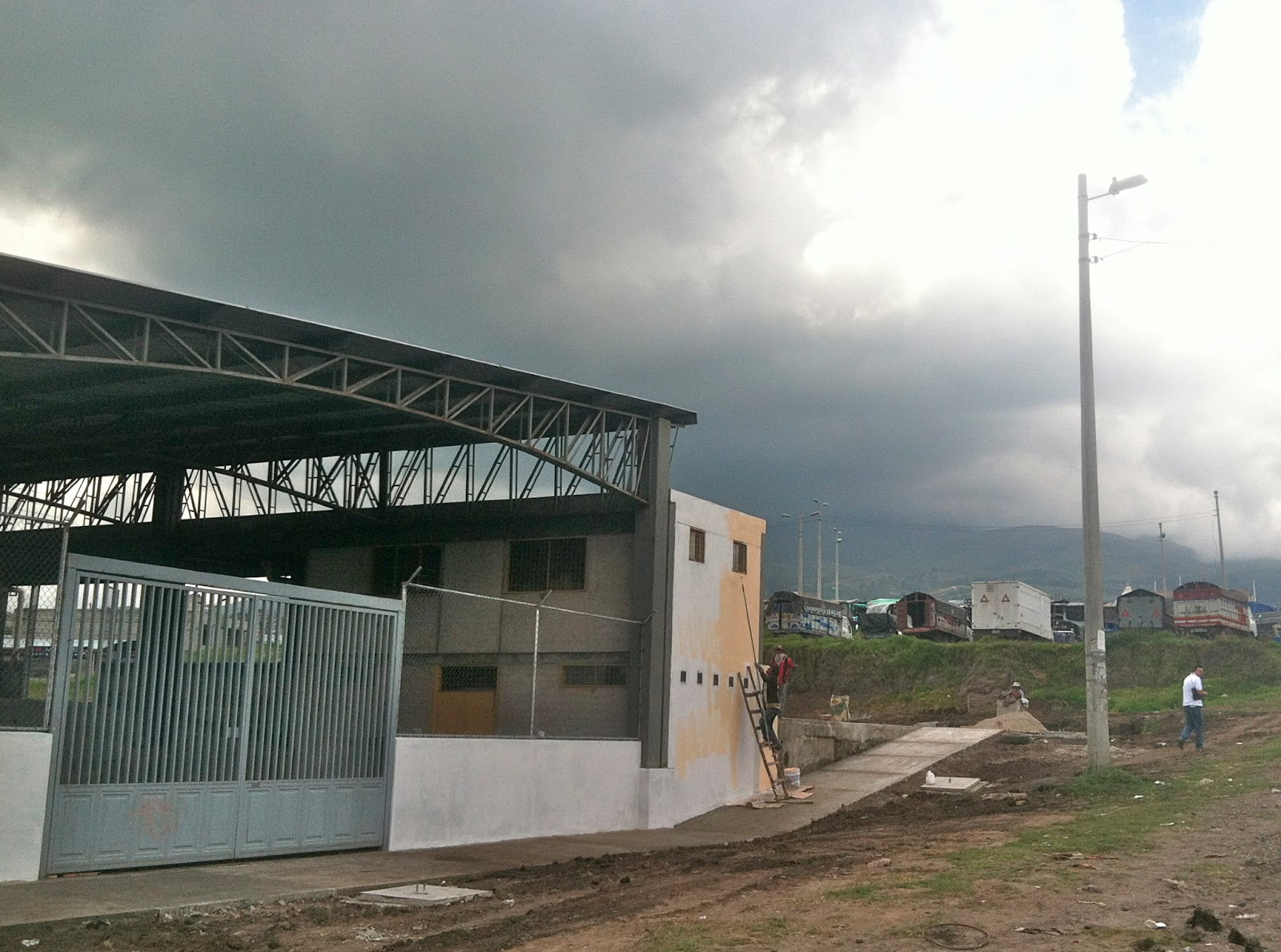
We all took a bus to a market about half an hour away for just 25 cents each, carrying bags of school supplies, books and toys. At the edge of the market is an un-used warehouse, with lots of open space and air.  About 30 children slowly appeared, ranging in age from babies to 10 year-olds. Most were between 3 and 8 years old.  UBECI establishes contacts with the families who let their children attend the class.
The building where we had class, with the market behind.
Once we get permission, we will post pictures of the classes.
 First, the children washed their hands in basins we brought. Then we placed mats on the ground, and spread the toys and books we brought. It was playtime!!  This is exactly where your donations are useful - everything we bring has been donated from generous people. We spent about an hour playing and reading with the children. I held a baby boy who was very happy just putting plastic toys in his mouth. His brother, who was maybe 4, read aloud from a Spanish version of One Fish Two Fish. He read very well, and helped me with some pronunciation.  Later on, I read the same book to a girl who was holding her baby brother on her lap. She helped me too, and read aloud herself in a very soft voice.

Next, the toys and books were gathered up, and all the children and staff formed a large circle. We sang Spanish children’s songs that involve clapping hands and stomping feet. We danced to some music, following Danny, one of the permanent UBECI staff.  It was essentially an 80’s aerobics class for the kids, but without the headbands and Spandex. A game of Red Light Green Light ended this portion of the morning.

A basic math lesson on shapes came next. The older kids were given chalk, and drew rectangles of different sizes on the ground. Then we returned to the mats and each child got a worksheet with different shapes on it. They had to identify all of the rectangles, and only color those in. Most of the children did a great job!

The little kids did a different activity, gluing pompoms to shapes on paper. Emma worked with that group, while Mike and I were with the older ones.  Then it was time to clear up and wash again, and a few volunteers walked the children back to their families in the market.

The class finished at 12:30. Some staff stayed for another afternoon class, while we met with Monica at the UBECI office to sort out the donations we brought. She is the co-Director of UBECI with her husband Byron, who is the founder of this organization.  They have worked very hard to create a viable program that directly relates to the local lifestyle. The children love attending, and they show their love to us so openly and comfortably. I suppose they are used to seeing lots of unfamiliar faces, as volunteers come and go. We are excited and honored to contribute to UBECI, and they welcome us enthusiastically.

After their normal three-day weekend, we will return on Tuesday morning. We are looking forwards to it!

Friday, February 1, 2013

Finally Here

-->
January 31st, 2013

Quito, 7:00 a.m.

We are here. Twenty five years after first thinking about such a trip, about three years since we started planning more realistically, and 26 hours since we made our final packing decisions, we woke up this morning to the unfamiliar sounds and smells of a different home here in Quito. We arrived here at about 9:00 last night after a pleasingly uneventful flight via Miami with all parts of the journey going smoothly –not counting the fact that we almost left our most important carry-on bag (laptop, documents etc.) on the floor by the luggage carousel.


We were greeted at the airport by Danny, who works for UBECI.  They had the van to shuttle us and our six bags (most of this donations for the schools) to our homestay on the south side of the city.  It was dark, so our views were limited to the streets we drove through, but did include a glimpse of a fire juggler entertaining people in cars waiting at a traffic light.  You don’t get that in Maynard!

Our host family is very welcoming and provided our first real opportunity to practice Spanish. They are Orlando, Marlena (currently expecting another child in March)and Anita who is sixteen – hopefully good company for Emma.  We sat up talking for a while.  Fortunately, while Orlando and Marlena speak very little English, Anita speaks enough to get us out of trouble.

Today is assigned to acclimatizing ourselves to the neighborhood, organizing our stuff, and, most importantly of all right now, NOT packing or preparing our house for departure.

8:30 p.m.
If you have travelled, you are no doubt familiar with the feeling of surprise at the end of the first day when you realize that it really has only been one day away from home. Already we have become settled in to some of the new routine here.  Our phones that we bought, unlocked, in the US, now have chips and numbers stored.  The beauty of this however is that we really only plan to use them for local business and emergencies – say, if Emma gets left behind on abus somewhere.  Much as I use my phone a lot at home, I am very much looking forwards to this not being a part of my regular day. It felt a bit crazy going to a mall to get the chips, but I don’t plan to return there too often.

The area around us is characterized mostly by 3-4 story apartment buildings, most with balconies and flat roofs, and many with the tell-tale signs of rebar protruding from various corners indicating an ongoing desire to add to the structures. The roof of our building provides a spectacular view looking both north and south along the Quito valley, with high mountains, especially on the west side. The great Basillica can be seen a couple of miles to the north, and the only other outstanding landmark we can see from here is a substantial angel statue on top of a hill close by. 
View from the roof of our home - you can just make out the winged version of the Madonna on
 El Panecillo (the hill)  to the right.
Pedestrians must be constantly on their guard here.  Unlike Maynard where a car will stop if you so much as look across to the other side of the street, the general rule here appears to be speed up first, ask questions later. Buses and taxis dominate the traffic, though there are still many trucks and, by US standards, undersized vans that maneuver briskly through the crowded streets.  For all that, it does not seem overly aggressive so much as a mutual polite agreement that everybody has the right to get to the end of the street first. 

Our Spanish is already improving. Visits to a general store,the phone place, a fish market, a health clinic (Anita fell ill today), and abarber shop (for Orlando) will do that. On Tuesday (Martes) we start three hours of lessons each afternoon.  Bueno!


Tuesday, January 29, 2013

Moving Out -


No Condition is Permanent. This was a common sticker on the dashboards of dangerously fast long-distance taxi drivers in Nigeria.  It is thrilling to know that we are soon to be thrown into a world with so many differences from our own, yet connected in more ways than we normally appreciate. Transience governs much of our world, despite our attempts to slow it down at times. 

Our imminent departure, like moving house, provides a strong incentive to clear out our possessions.  It is already depressing to consider the speed at which we acquire a new gadget for audio (or any other medium), and must finally let go of older, once treasured belongings. This is the last tape player to leave our ownership, following the exit of our record player about six years ago. The replacement of course, plus all music can fit in my pocket.


No, we will not take this audio relic to Ecuador, even though it is in good working condition.  However, thanks to the generosity of many here in town, we cruised past the target of 150 pounds of donations, exceeding 200 lbs.  You provided a good mix of games, toys, books, clothing and especially basic school supplies. They are now bagged up and ready for check-in.  Thank you again for your kindness and generosity.

Wednesday, January 16, 2013

Two Weeks 'til Departure


We were among the surprised members of the population here in New England when enough snow arrived to suspend the schools and to make driving somewhat tricky.  It looks pretty enough from our kitchen, but Quito does look a little warmer.


Quito - From http://www.weather-forecast.com
People have been asking how they can help out with support for the schools where we will work.  Already, many of you have generously donated clothing, books, instructional toys (like Lego), and general school supplies.  Our goal is to collect about 150 lbs (three suitcases worth), so e-mail us if you have something as we may fill up quite quickly. Any money donations can either go directly to the organizations through their websites (see links on the blog), or to Emma's UBECI market goods sale - a couple of dozen items still available such as dream catchers, necklaces and hacky sacks.


Here is the beginning of donations already.  Thank you so much.